A towel mill and a towel wholesaler answer the same enquiry and sell you different things. The mill weaves, dyes and finishes to your specification with a minimum set by its dye lot. The wholesaler sells what already exists. You will find both around Denizli, both will quote, and only one of them can make a towel to your weight and your size.
The distinction matters more in towelling than in most categories, because the specification is genuinely technical. Weight, loop construction, staple length and finishing chemistry are measurable properties, and a mill can hit a number while a wholesaler can only find something close.
Buying finished stock rather than commissioning it is covered in the Turkish towels wholesale guide, which also sets out GSM bands, bathrobes and how to tell a mill from a trader. Denizli's place among the clusters is in the manufacturers guide and on our Denizli page. This guide is about production: what a Turkish towel mill actually controls, how to specify a towel so a mill can quote it, what drives the minimum, how to read a quotation, what a certificate does and does not cover, and the tests to run before you approve a sample.
Note: Turkey Clothing Factory is a group of documented clothing factories in Turkey, producing for brands from 100 units. Minimums in this guide are indicative ranges, not quotes from a specific mill. We confirm exact MOQ and price with the factory when you send a brief.
Key takeaways
- A mill controls weight, loop, yarn and finish. A wholesaler controls none of them.
- Denizli is the centre: its exporters' association puts about 90 percent of Turkey's towel, bathrobe and bedding production there.
- Minimums are set mostly by the dye lot, indicatively 250 to 500 pieces per colour.
- Loop construction matters as much as GSM. Two 550 GSM towels can feel completely different.
- Mills quote per piece or per kilo. Confirm which before comparing anything.
- Check OEKO-TEX by number, and check that the certificate lists towels, not only fabric.
- Turkish towels land duty-free in the EU (A.TR) and in the UK with preference (12 percent without), and pay 9.1 percent in the US, where Turkey has no preference.
Have a product in mind? Tell us the product, quantity and timeline and our team replies within 24 hours. Send a brief →
What Does a Towel Mill Actually Control?
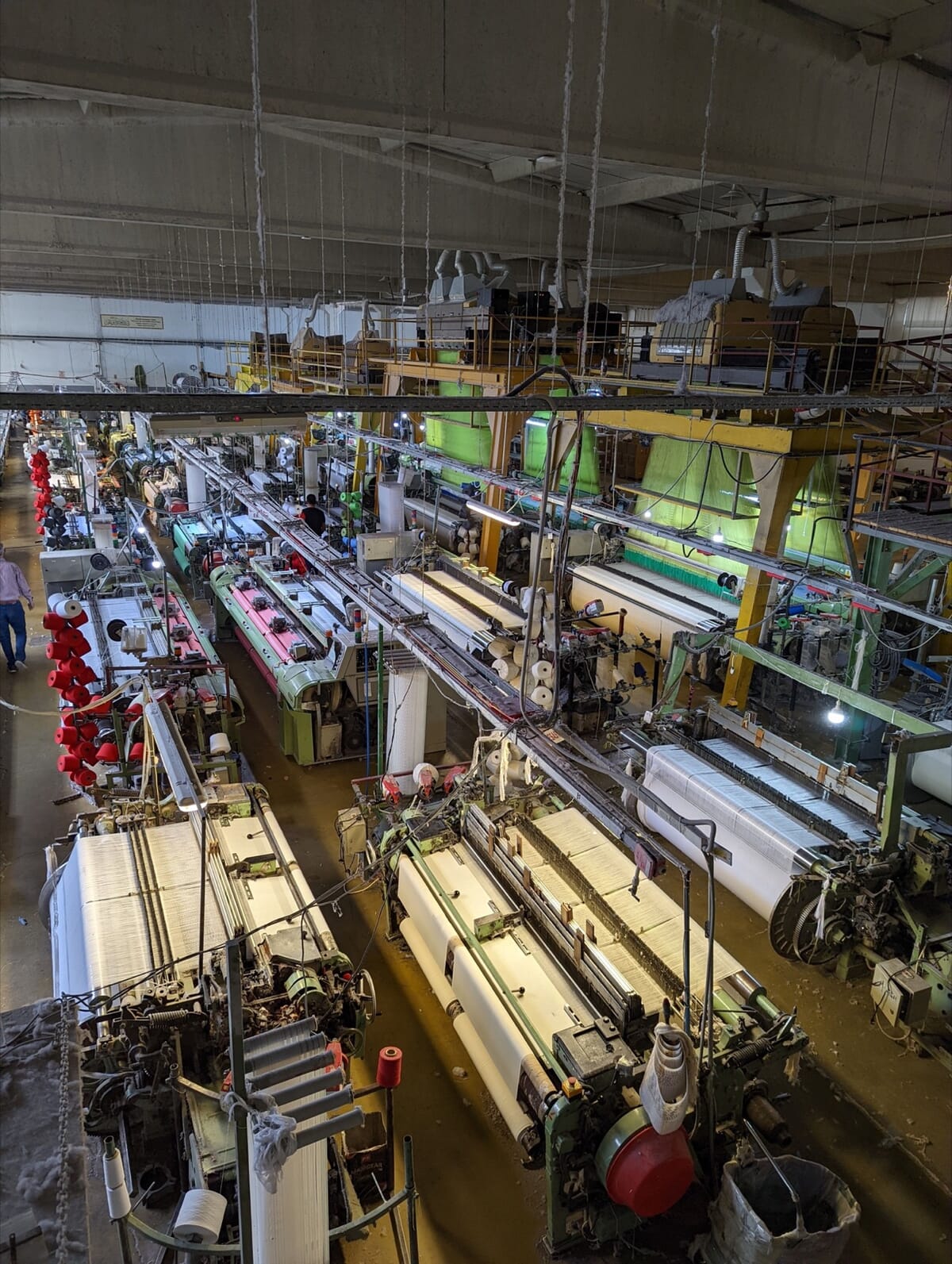
Four variables, and a wholesaler controls none of them. This is the practical difference between commissioning and buying stock, and it decides which one you should be talking to. If your towel needs to be a specific weight in a specific colour at a specific size, you need a mill.
| Variable | What the mill sets | Effect on the product |
|---|---|---|
| Yarn | Staple length, twist, combed or carded | Shedding, durability, softness |
| Weight | GSM, by pile density and height | Hand, absorbency, drying time |
| Loop construction | Loop height, density, single or double | How plush it feels at a given weight |
| Finish | Softeners, enzyme treatment, none | Initial hand, and how it changes after washing |
General textile practice. Mills vary in the terminology they use, particularly for finishing processes.
Loop construction is the underrated one. Two towels at 550 GSM can feel entirely different depending on whether the weight comes from dense short loops or sparser tall ones. Brands specify GSM and are surprised when the sample does not feel like the reference towel they sent.
If you have a reference towel you like, send it. A mill can measure what it is and reproduce the construction, which is far more reliable than describing it in words across a language gap.
Why Denizli. The Denizli Exporters' Association (DENİB) puts about 90 percent of Turkey's towel, bathrobe and bedding production in Denizli, and reports towel exports from the province of USD 410 million in the first eleven months of 2025 (Textilegence, January 2026). For a buyer that means weaving, dyeing and finishing capacity for terry sit close together, so most towel enquiries end up with a Denizli mill even when the company quoting is based elsewhere.
Citation Capsule: A towel mill controls yarn staple and twist, GSM weight, loop construction and finishing, while a wholesaler controls none of these. Loop height and density determine how plush a towel feels at a given weight, so two towels of identical GSM can feel substantially different depending on construction.
What Must a Commissioning Brief Contain?
Six lines, and with all six present a mill can quote without a single follow-up question. An enquiry carrying two of the six generates days of correspondence before anybody can price it, which is avoidable and costs you the speed that is one of the reasons to work with a Turkish supplier.
Size, finished, after washing. Terry shrinks. A mill quoting to a finished dimension is accounting for it; one quoting loom size is not. State which you mean.
Weight in GSM. Grams per square metre, and with yarn the main driver of cost, because towelling is priced by weight. For household retail, 500 to 600 is a common band.
Yarn. Combed or carded, long-staple or standard, and zero-twist if you want it. Combing removes short fibres, which is a large part of how much a towel sheds.
Loop. Reference a towel if you have one. Otherwise state whether you want dense and firm or tall and plush.
Colour. Stock shade or custom, because it can move the minimum by a couple of hundred pieces.
Border and hem. Plain hem, woven dobby border, or jacquard. The last one carries a loom set-up and a much higher minimum.
Citation Capsule: A towel specification requires finished size after washing, GSM weight, yarn type and staple, loop construction, colour as stock or custom, and border treatment. Terry shrinks in washing, so specifications must state whether dimensions refer to finished or loom size, and jacquard borders carry loom set-up costs and higher minimums.
Six lines a mill can quote from
- Finished size after washing, stated as such
- GSM, commonly 500 to 600 for household retail
- Yarn: combed or carded, long-staple or standard, zero-twist or not
- Loop: dense and firm, or tall and plush. Send a reference towel if you have one
- Colour: stock shade or custom
- Border: plain hem, dobby, or jacquard
Send a reference towel wherever possible. A mill can measure what it is and reproduce the construction, which beats describing pile height in words across a language gap.
No tech pack yet? Factories quote from specifications, not from photographs. A factory-ready single-style tech pack is $79: measurements, construction, fabric, trims and labelling in the format a Turkish factory costs from.
What Will a Mill Actually Run for You?
Mostly by the dye lot rather than the loom, which is why the answer changes so much with the colour. A mill running a stock shade is adding your pieces to a batch it was going to dye anyway. A custom shade means the batch exists only for you. The ranges below are indicative and the same as those in our wholesale guide; each mill sets its own.
| Scenario | Workable minimum | What sets it |
|---|---|---|
| Stock towel, stock colour, your embroidery | Under 100 pieces | Embroidery batch only |
| Mill construction, stock colour | 250 to 300 pieces | Shared dye lot |
| Mill construction, custom colour | 400 to 500 pieces | Dedicated dye batch |
| Custom loop or weight | 500 pieces and up | Loom set-up |
| Jacquard or woven border | 500 to 1,000 pieces | Loom set-up for the pattern |
Indicative ranges, not quotes from any named mill. We confirm exact MOQ and price with the factory when you send a brief.
The first row is how many small orders actually happen. Hotels, gyms and small hospitality brands often do not commission a towel at all. They take a mill's existing product, add an embroidered logo, and the minimum falls because no dyeing is involved.
A brand that hears "our minimum is 500" and walks away may have had a 100-piece option available and not known to ask for it.
Citation Capsule: Towel minimums are set mostly by the dye lot rather than the loom. Mill construction in a stock colour is indicatively workable from 250 to 300 pieces, rising to 400 to 500 for a custom shade. Adding embroidery to a mill's existing towel avoids dyeing entirely and can bring the minimum below 100 pieces.
How Do Mills Quote Towels?
Per piece or per kilogram, and the two conventions produce numbers that look nothing alike for the same product. Towelling is sold by weight at the mill because that is how it comes off the loom, and converted to a per-piece price once the size is fixed.
Converting needs the finished weight of one towel. A 550 GSM bath towel at 70 by 140 centimetres weighs about 540 grams, so a price per kilo divides across roughly two towels. Get the size or the weight wrong and the comparison inverts.
Ask what the price includes. Hemmed and finished, packed in polybags, with your label sewn in, are three different prices. A quotation for loose finished goods compared against a competitor's packed price is not a comparison.
Ask about the embroidery separately. Logo embroidery is priced per unit by stitch count, and a dense logo on 500 towels is a meaningful line rather than a rounding error.
Citation Capsule: Turkish towel mills quote per piece or per kilogram, and converting between them requires the finished weight of a single towel, which depends on both GSM and dimensions. Hemmed goods, packed goods and goods with sewn-in labels carry different prices, and embroidery is priced separately by stitch count.
What Certifications Should a Towel Mill Have?
OEKO-TEX Standard 100 is the first one to ask for, because towels are in direct contact with skin. The standard tests articles against a list of more than 1,000 substances, groups products by skin contact, with direct-skin-contact items such as bed linen in product class 2, and certificates are issued for one year (OEKO-TEX). The certificate number is verifiable in about a minute.
Check the number, not the PDF. Search it in OEKO-TEX Label Check and note whose company name appears. A trading company presenting a mill's certificate is common and worth understanding before you order.
GOTS applies if the cotton is organic. That is a separate standard covering organic content and the processing chain, verifiable in the GOTS certified suppliers database. OEKO-TEX Standard 100 is a test for harmful substances and says nothing about organic content; the two are often confused.
Read what the certificate covers. An OEKO-TEX certificate covers the articles listed on it, not the company in general. A certificate for terry fabric is not one for finished towels, and a towel is a made-up article with thread and labels added. Check that the listed articles match what you are buying.
For organic towels, ask for a transaction certificate on the order itself. A GOTS scope certificate says the mill can produce certified goods. A transaction certificate, issued by the mill's certification body only to a seller holding a valid scope certificate, verifies the products actually sold as GOTS-certified (GOTS transaction certificate procedure). Holding the first is not the same as having the second.
Social compliance is a separate axis again. amfori BSCI, SEDEX and WRAP audits address labour conditions rather than the product, and a retailer with a supplier code of conduct may require one of them irrespective of OEKO-TEX. Ask which the mill holds and when it was last audited.
Ask where each stage happens. If the mill sends hemming or embroidery to a subcontractor, ask whether that unit is covered too. That is the practical reason to know where each stage physically happens before relying on a certificate for a claim you intend to print.
Citation Capsule: OEKO-TEX Standard 100 tests articles for harmful substances, covers the articles listed on the certificate, and certificate numbers are verifiable in the public Label Check database. GOTS is a separate standard covering organic content and processing, with transaction certificates for certified goods sold, while BSCI and SEDEX audits cover working conditions rather than product properties.
What Duty and Freight Apply to Turkish Towels?
No duty into the European Union, none into the United Kingdom when the towels qualify for preference, and 9.1 percent plus an additional 12.5 percent into the United States. Turkish goods enter the EU free of duty under the Customs Union with an A.TR movement certificate (European Commission). The UK charges 0 percent on cotton terry towels from Turkey under the UK-Turkey trade agreement when they meet its rules of origin and carry an origin declaration, against 12 percent without preference (UK Government; UK Trade Tariff).
Turkey has no trade preference with the United States, so the ordinary rate applies. Cotton terry towels classify as made-up textile articles (subheading 6302.60) rather than garments, which puts that rate below most apparel: 9.1 percent against 16.5 percent on a cotton knit tee (USITC). On top of that ordinary rate, products of Türkiye pay an additional 12.5 percent under Section 301 since 24 July 2026 (heading 9903.05.79), so 21.6 percent in all. The import duty guide covers the wider picture.
| Landing in | Duty on towels | Against apparel |
|---|---|---|
| European Union | Zero, with A.TR | Same |
| United Kingdom | Zero with preference (origin rules met), 12 percent without | Same |
| United States | 9.1 percent plus 12.5 percent (Section 301), no preference | Lower. 16.5 percent on a cotton knit tee |
Sources: European Commission Access2Markets; UK Government; UK Trade Tariff (6302600010); USITC Harmonized Tariff Schedule (6302.60.00). Checked 23 October 2026; rates depend on exact classification, and the US figures are ordinary rates, to which Section 301 adds 12.5 percent.
Freight behaves differently from apparel. Towels are dense and heavy for their value, so freight is a larger proportion of landed cost and a forwarder's basis of charge matters more. That increases the value of road transport into Europe and makes the sea leg to America a heavier drag than it is on garments.
Citation Capsule: Turkish towels enter the European Union duty-free under the Customs Union with an A.TR and the United Kingdom at zero tariff when they qualify for preference (12 percent otherwise), while United States importers pay the ordinary 9.1 percent plus 12.5 percent under Section 301, lower than most apparel because cotton terry towels classify as made-up textile articles rather than garments. Towels are dense relative to value, so freight forms a larger share of landed cost than on apparel.
Try it free: pressure-test your landed cost with the Turkey production cost calculator. 60 seconds, no email required.
How Do You Approve a Mill Sample?
Wash it three times first, and then run four checks. Terry changes noticeably over its first washes, shrinking, shedding loose fibre and losing finishing softeners. A sample assessed dry tells you a great deal about the towel you were sent and much less about the towel your customer will actually own.
Shrinkage against the spec. Measure before and after. Lengthwise shrinkage is normal and larger than across. Anything outside the mill's stated tolerance is a specification conversation.
Shedding. Check the machine filter. Heavy lint points to short-staple yarn or loops damaged in finishing, and it is a common customer complaint.
Absorbency. Float the towel on water. A good one sinks and takes up water quickly. One that sits on the surface often still carries softener, which is worth raising with the mill before you approve it.
Weight, verified. Cut a known area and weigh it. A towel quoted at 550 GSM delivered at 500 is a cost saving you did not agree to, and it is worth checking on the first bulk delivery as well as the sample.
Four checks after three washes
- Shrinkage measured before and after, against the mill's stated tolerance
- Shedding judged from the machine filter, not from the towel
- Absorbency by floating. A good towel sinks and takes up water
- Weight verified by cutting and weighing a known area
A towel quoted at 550 GSM and delivered at 500 is a saving you did not agree to. Check it on the first bulk delivery as well as on the sample.
Working With Turkish Towel Mills
Treat "Turkish cotton" as a claim to check. Turkey grows cotton, but its mills use more than the country produces and import the rest, from the United States and Brazil among others (USDA Foreign Agricultural Service). If you want to print "Turkish cotton" on the label, ask the mill where the fibre comes from and what paperwork backs it; a towel woven in Turkey from imported cotton is a Turkish-made towel, not necessarily a Turkish-cotton one.
Send a reference towel wherever you have one available. A mill can measure an existing towel's construction, yarn and weight and then reproduce it, which is far more reliable than interpreting a written description of pile height and hand across a language gap. It removes a common source of sample disappointment.
Then be deliberate about colour, because it can be the difference between a 250-piece minimum and a 500-piece one. And if your quantity is genuinely small, ask about embroidery on an existing mill towel before concluding the order is too small to place.
Finally, wash before you approve. Everything that goes wrong with a towel goes wrong in the wash, and it is the cheapest test available.
Commissioning from a mill is a different transaction from buying stock, and the difference is control rather than price. You choose the yarn, the weight, the loop and the finish, and you own the specification afterwards. Buying finished stock gives you none of that and gets goods into a warehouse sooner.
The decision usually comes down to repetition. A one-off buy for a season does not justify a mill minimum or a sampling round. A line you intend to carry for years does, because every subsequent order runs against a specification that already exists and a mill that already knows it.
Expect the first order to cost more than the second. Sampling, a shade approval and a first production run carry setup that does not recur. Judging the relationship on the first invoice alone understates what it looks like at the third.
Frequently Asked Questions
What is the minimum order from a Turkish towel mill?
Indicatively 250 to 300 pieces in a stock colour and 400 to 500 in a custom shade, because the dye lot rather than the loom mostly sets the floor. Embroidery on a mill's existing towel avoids dyeing altogether and can bring the minimum below 100 pieces.
What GSM should I specify?
Commonly between 500 and 600 for household retail, which balances substantial hand against drying time. Loop construction matters as much as weight: two towels at the same GSM feel different depending on whether the weight comes from dense short loops or sparser tall ones.
Which certificate should a Turkish towel mill have?
Ask for an OEKO-TEX Standard 100 certificate, because towels are in direct contact with skin. Verify the certificate number in the public OEKO-TEX Label Check database, note whose company name appears on it, and check that the listed articles include finished towels rather than only fabric.
How do towel mills price their quotations?
Per piece or per kilogram, and converting between them requires the finished weight of one towel, which depends on GSM and dimensions. Hemmed, packed and labelled goods are different prices, and embroidery is quoted separately by stitch count.
Should I send a reference towel?
Yes, wherever possible. A mill can measure an existing towel's construction, yarn and weight and reproduce it, which is considerably more reliable than interpreting a written description of pile height and hand across a language gap.
Send the GSM, the finished size, the piece count by colour and where the goods are landing. Our team replies normally within 24 hours with an honest answer on fit. If a factory in our group can make it, we place and manage your production there, and the factory bills you directly. No commissions. No markups. The factory bills you directly.
Get in contact Download the directory ($49)Need a tech pack? Get a factory-ready single-style tech pack for $79. See what's included.
Editorial note: certification marks and trademarks referenced here are the property of their respective owners. Minimums are indicative ranges, not quotes from any individual mill, and vary by product and season. Duty rates were checked against the official sources below on 23 October 2026 and can change. This is general guidance, not customs advice: confirm the classification and duty position for your own product before committing.
Sources
- Textilegence (5 January 2026): Denizli Exporters' Association (DENİB) on Denizli's share of Turkish towel, bathrobe and bedding production and its 2025 exports.
- USDA Foreign Agricultural Service (2 April 2025): Türkiye Cotton and Products Annual, GAIN report TU2025-0013, cotton production, consumption and imports for 2025/26.
- OEKO-TEX: STANDARD 100, product classes, tested substances and certificate validity.
- OEKO-TEX Label Check: public verification of certificate numbers.
- Global Organic Textile Standard: public database of GOTS-certified suppliers.
- Global Organic Textile Standard (2026): procedure for the issuance of transaction certificates, version 4.0.
- European Commission, Access2Markets: the EU-Turkey Customs Union and the A.TR.
- UK Government: summary of the UK-Turkey trade agreement, in force since 1 January 2021.
- UK Trade Tariff: commodity 6302600010, third-country and Turkey preference rates.
- USITC Harmonized Tariff Schedule: heading 6302.60.00 and duty rates.
- Office of the US Trade Representative (July 2026): fact sheet on the Section 301 action, which adds 12.5 percent to US duty on products of Türkiye entered from 24 July 2026 (HTS heading 9903.05.79).